Research Protocol
This document outlines the overall vision, methodological approach, and analytical strategy for the project Deriving insights for research data sharing from a large-scale data sharing initiative in Canada. It is intended as a living reference that evolves alongside the project, articulating decisions at the level of design and strategy rather than documenting granular operational steps, which are covered in dedicated sub-protocols. The study’s human participants research is conducted under McGill REB file #26-08-029.
1 Motivation and Problem Statement
Health data sharing is widely understood as a technical challenge — one of interoperability, access infrastructure, and standardization. But for those who actually coordinate it, the experience is primarily organizational: negotiating agreements across institutions, aligning diverse stakeholders with incompatible timelines, and sustaining collaborative relationships under conditions of uncertainty and urgency. These organizational dimensions have remained largely invisible in research on health data infrastructure, crowded out by a strong emphasis on technical solutions.
This project takes the organizational dimensions of health data sharing seriously as objects of empirical investigation. It does so by analyzing the administrative correspondence generated during the creation and operation of the COVID-19 Immunity Task Force (CITF) Databank — a pan-Canadian initiative that assembled health records from over 100 COVID-19 studies across the country. The project analyzes the Databank’s email archive and questionnaire responses to better understand the coordination work that made data sharing happen.
The project pursues two interrelated objectives:
Objective 1: Characterize the coordination processes among the CITF Databank’s partners, core Databank personnel, and other related stakeholders.
Objective 2: Identify human and organizational determinants of observed coordination behaviours.
2 Case Description
The CITF Databank serves as the empirical case for this study. Established in April 2020, the CITF was mandated to catalyze, fund, and harmonize knowledge about SARS-CoV-2 immunity to support federal, provincial, and territorial decision-making. The Databank centralized research data from CITF-funded studies, ultimately assembling a harmonized dataset drawing on over 165,000 individual participant health records from studies conducted across Canada.
The Databank’s pan-Canadian scope — involving data sharing across multiple universities, research institutes, hospitals, and governmental agencies, under pandemic conditions — makes it an unusually rich setting for examining how large-scale health data sharing governance is coordinated in practice. It is neither a routine data request nor a purpose-built federated infrastructure, but something in between: a concentrated administrative effort to retrofit collaborative data sharing onto an ecosystem of independently conducted studies with heterogeneous governance arrangements.
The Databank was led by a core team within the CITF Secretariat, supported by dedicated personnel at McGill University’s Office of Sponsored Research and by external experts in data governance and harmonization. This organizational structure — a central operational core interacting with distributed study teams and external institutional partners — is reflected directly in the email corpus and is a primary object of analysis.
3 Data Sources
3.1 Email Corpus
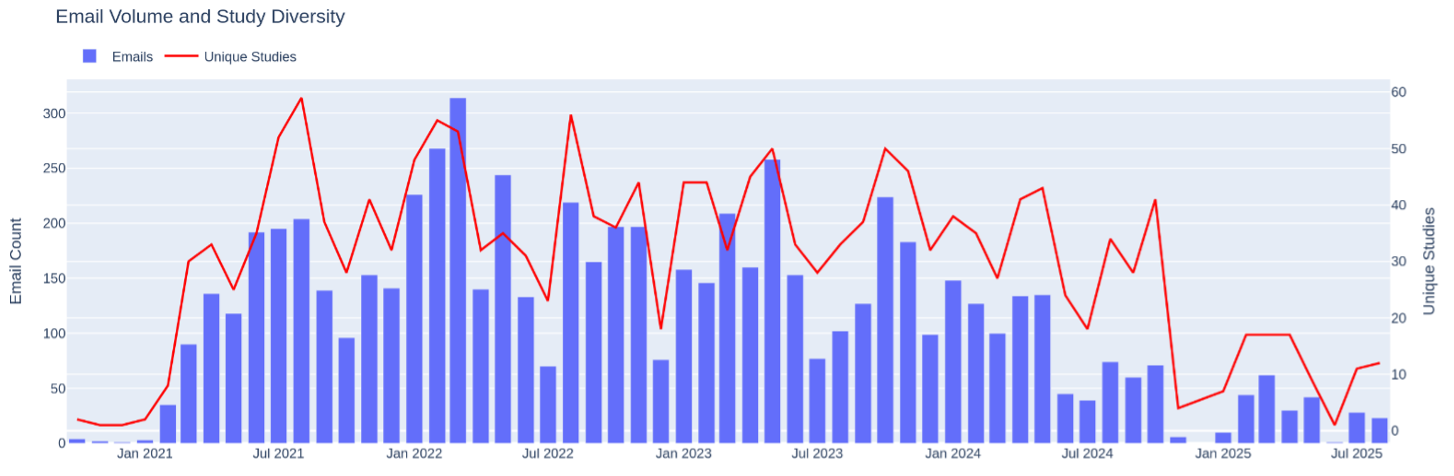
The primary data source is the email archive of the CITF Databank. A pilot phase established a pipeline to clean, translate, de-identify and de-duplicate an initial set of emails from the inbox of the Databank’s central operations manager, producing a small working corpus covering correspondence with 100 partner studies from February 2021 to September 2025 (Figure 1).
To check whether the pipeline’s output was usable, topic modelling was applied to the processed corpus, identifying 14 coherent topics organized into four thematic clusters. These topics were then analyzed for their distribution across the data sharing lifecycle, across sender roles, and across gender, and for how they co-occurred with one another, surfacing a preliminary set of observations about the structure and timing of coordination work, now reported in the topic modelling preprint.
The rest of the project’s email corpus is assembled by applying the pipeline developed from the pilot phase to additional mailboxes belonging to relevant individuals, including the Databank’s Scientific Director and Data Managers. The expansion proceeds iteratively; the data processing and analysis pipeline validated through the pilot is applied to each new mailbox in sequence, with the corpus growing in a controlled and documented fashion. The expanded corpus will then serve as the basis for further analysis, including a reiteration of the topic modelling, a network analysis of communication patterns, and an analysis of the effects of data complexity.
Emails relating to broader CITF operational communications not associated with specific studies are not included. This reflects the project’s focus on relationships between the CITF and its partners that contribute data, rather than on other aspects of CITF operations.
3.2 Questionnaire
The secondary data source is a questionnaire administered to individuals who participated in the CITF Databank initiative, identified through the CITF’s roster of data contributors, including project leaders, data managers, and key technical and administrative personnel. Project leaders may also be asked to forward the questionnaire to team members who worked in a less visible capacity and whose contact information the CITF does not maintain. A waiver of consent applies to the email data; questionnaire participants provide informed consent prior to beginning. Recruitment and consent procedures are detailed in the ethics protocol, recruitment materials, and informed consent document.
The questionnaire is structured around four domains: (1) participants’ professional backgrounds and experiences; (2) independent and collaborative activities; (3) impact and change over time; and (4) demographic data. The first domain also serves as a branching mechanism, routing respondents to role-appropriate question blocks in the remaining sections. Questions in the second and third domains correspond to the topic and phase categories established by the email analysis. The demographic domain collects respondents’ gender and institutional affiliation, which correspond with variables structuring the email analysis, therefore enabling comparison across the two data sources at the level of aggregate categories rather than individual identity. The full question set is documented in the questionnaire protocol. A brief pilot with 2–3 respondents will precede full distribution of the questionnaire.
4 Methodological Design
The work is carried out in three work packages.
4.1 Work Package 1: Email Corpus Processing
Raw emails are preprocessed to isolate substantive content. Rule-based cleaning removes confidentiality disclaimers, meeting-invite boilerplate, forwarded-message headers, institutional signatures, automated system notifications, and near-empty or excessively long messages. Bilingual messages are processed to retain English content where identifiable; remaining French text is translated using OPUS-MT. All messages are de-identified using the Presidio framework, anonymizing personal names, email addresses, and URLs. Duplicate messages within studies are removed using normalized text hashing, and emails are linked to partner studies wherever possible to enable study-level analysis.
Although considerable effort was made to ensure that this is as automated as possible, some human review and processing was necessary. The vast majority of human review was done by a single research assistant to ensure consistency across the corpus, who documented her own decisions and actions.
4.2 Work Package 2: Email Corpus Analysis
4.2.1 Topic Modelling
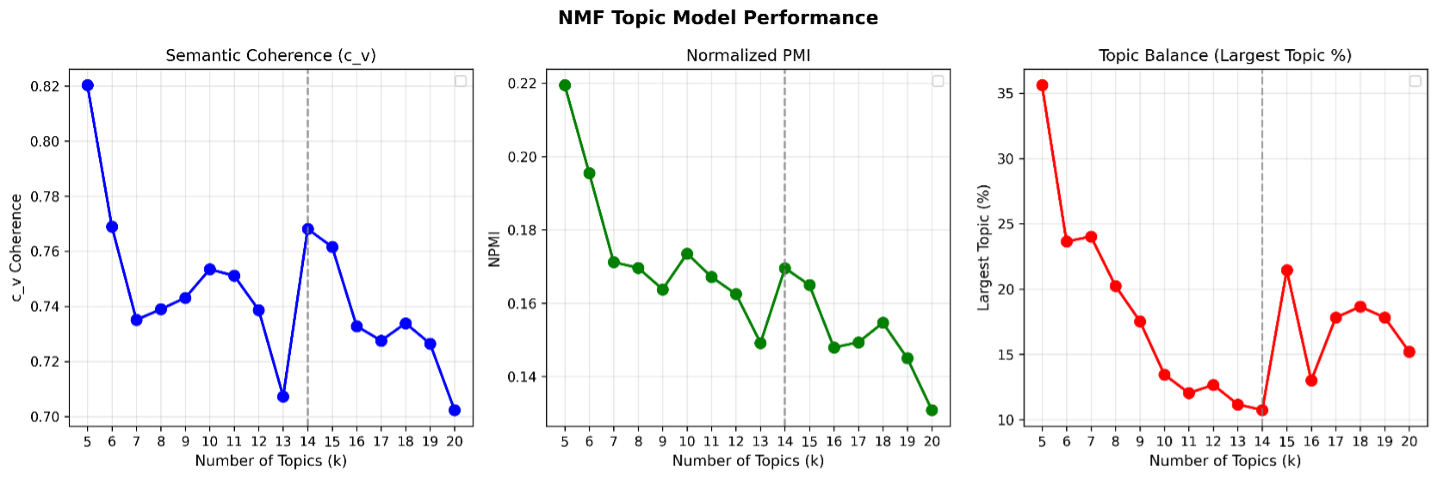
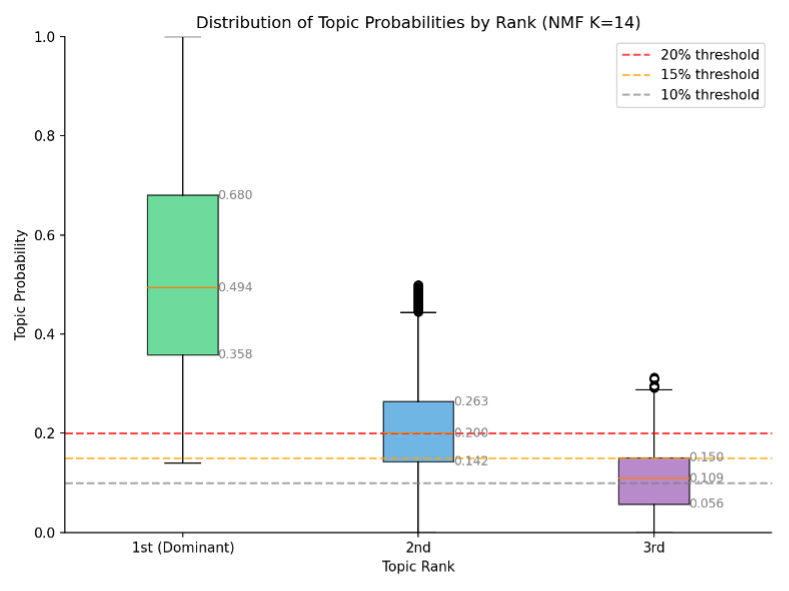
Non-negative Matrix Factorization (NMF) was selected as the topic modelling approach through systematic evaluation against K-Means clustering, Latent Dirichlet Allocation (LDA), and BERTopic. With domain-specific stopword curation and part-of-speech filtering, NMF outperformed all alternatives across coherence metrics (Figure 2), and k = 14 was selected as the optimal balance between coherence (c_v = 0.768, NPMI = 0.170), granularity (lowest maximum cluster size at 10.7%), and topic diversity (0.914). A 15% probability threshold is applied for multi-topic assignment (Figure 3), validated through research team review of representative emails.
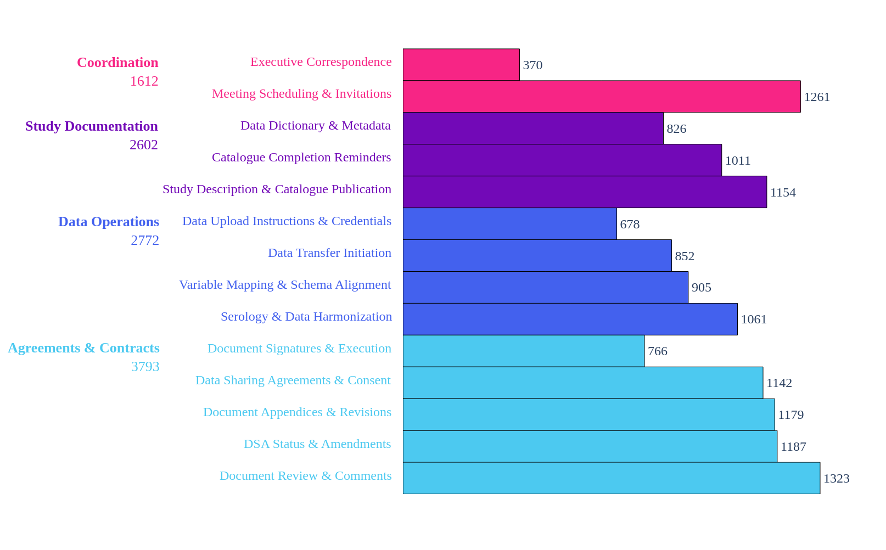
Topic labels, descriptions, and thematic groupings were generated using Meta-Llama-3.1-8B-Instruct, selected from four locally evaluated open-source models, and refined by the research team. The 14 resulting topics and their thematic groupings are shown in Table 1, and their overall distribution across the corpus in Figure 4. The full methodological rationale for these decisions, including evaluation results for competing approaches and threshold sensitivity analysis, is documented in the topic modelling paper.
| Topic Label | Theme | Top 5 Keywords | c_v |
|---|---|---|---|
| Executive Correspondence | Coordination | correspondence, executive, director, contact, proposal | 0.497 |
| Meeting Scheduling & Invitations | Coordination | meet, invite, zoom, availability, schedule | 0.473 |
| Data Sharing Agreements & Consent | Agreements & Contracts | agreement, sharing, consent, contract, framework | 0.804 |
| DSA Status & Amendments | Agreements & Contracts | dsa, extension, amendment, contract, status | 0.543 |
| Document Appendices & Revisions | Agreements & Contracts | appendix, version, pdf, framework, accept | 0.861 |
| Document Review & Comments | Agreements & Contracts | comment, draft, approval, description, correction | 0.836 |
| Document Signatures & Execution | Agreements & Contracts | signature, sign, copy, execute, version | 0.759 |
| Study Description & Catalogue Publication | Study Documentation | description, participant, catalogue, publish, logo | 0.930 |
| Data Dictionary & Metadata | Study Documentation | variable, dictionary, questionnaire, scale, code | 0.878 |
| Catalogue Completion Reminders | Study Documentation | maelstrom, catalogue, support, complete, collaboration | 0.805 |
| Data Upload Instructions & Credentials | Data Operations | upload, pydio, form, instruction, refresh | 0.956 |
| Data Transfer Initiation | Data Operations | transfer, preparation, willingness, commence, process | 0.712 |
| Variable Mapping & Schema Alignment | Data Operations | variable, list, sheet, map, schema | 0.889 |
| Serology & Data Harmonization | Data Operations | serology, harmonization, effort, survey, assay | 0.805 |
4.2.2 Analytical Dimensions
The pilot corpus analysis is reported in the topic modelling preprint, which covers: topic co-occurrence structure; the distribution of topics across the six phases of the data sharing lifecycle; the distribution of topics and email-to-sender ratios across five sender role categories; and an exploratory gender analysis of coordination labour. As a test of the pipeline on a limited corpus, it produced preliminary observations rather than confirmed findings, including a structural separation between governance and data operations workstreams, an 18:1 ratio of administrative to technical time (median 395 days in DSA negotiation versus 22 days for technical cataloguing), and gendered patterns in topic and phase distributions, all of which the full analysis is designed to test against the expanded corpus.
The expansion of the corpus to additional mailboxes moves the project from a pipeline feasibility test on a single mailbox to the project’s actual analysis, extending it across a broader and more organizationally diverse set of perspectives and testing whether the pilot’s preliminary observations hold at scale.
4.2.3 Network Analysis
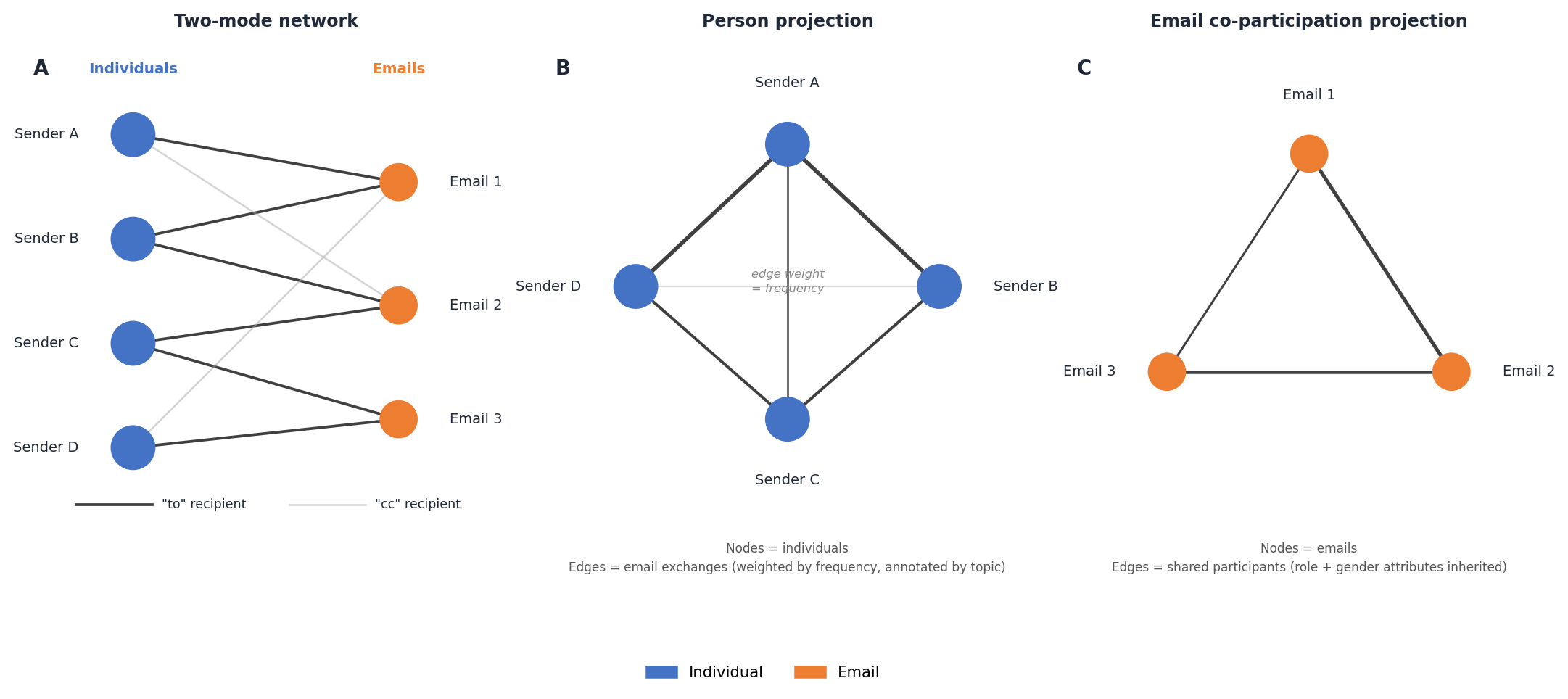
Network analysis extends the topic-level findings by examining the communication structures through which coordination was enacted. The network is constructed as a two-mode heterogeneous graph in which nodes represent individuals and emails, and edges represent communication relationships, with directional edges from sender to “to” recipient and from sender to “cc” recipient. High-volume cc routing that represents systemic notification rather than targeted communication is excluded to avoid distorting the overall structure. The overall graph structure and its two one-mode projections are illustrated in Figure 5.
Two one-mode projections are derived for separate analyses.
In the person-projection, nodes represent individuals and edges represent email communication weighted by frequency, with topic labels inherited from the emails exchanged. This projection supports several lines of inquiry:
- Role × role communication patterns. How frequently do individuals in different roles communicate with one another, and what topics tend to define those connections?
- Betweenness centrality. Node betweenness centrality (Girvan-Newman method) identifies individuals who are structurally essential to holding the network together. Associations between betweenness scores and sender role and gender test whether certain categories are disproportionately positioned as structural brokers. For the highest-ranked nodes, we further characterize what types of actors they connect and what topics tend to carry those bridging relationships — expected to reveal sharp phase-transition dynamics, for instance where data managers bridge study teams and the Harmonization Group.
- Community detection. Edge betweenness community detection identifies insular clusters. We expect the Harmonization Group (Maelstrom) and individual study teams to form distinct clusters, with consortia of particular interest. For each community, the number of cross-cluster edges by role and gender will be examined, distinguishing actors who engage primarily within their local cluster from those who sustain broader cross-institutional coordination.
In the email co-participation projection, nodes represent emails and edges connect emails that share participating individuals, with edges inheriting role and gender attributes from their senders. This supports analysis of which topics are connected through shared participants and which roles and gender categories tend to assert those inter-topic connections — complementing the topic co-occurrence analysis by revealing the human infrastructure underlying observed content clusters.
4.2.4 Comparative Fast/Slow Study Analysis
A targeted comparison of studies at the extremes of the Intro→DSA timeline distribution (pilot: median 395 days, range 7–1,526) examines their email records for distinguishing organizational patterns. This is supplemented by LLM-assisted qualitative comparison of representative email samples and will inform the identification of studies for targeted questionnaire follow-up, prioritizing those that illustrate theoretically interesting configurations of speed, institutional complexity, and engagement.
4.2.5 Impact of Data Complexity
4.3 Work Package 3: Questionnaire Analysis
4.3.1 Questionnaire Design
The questionnaire is organized around four sequential domains, detailed in the questionnaire protocol:
- Participants’ professional backgrounds and experiences. Drawing on life-history methods to understand how participants’ outlooks emerged from their professional trajectories, without seeking biographical detail per se.
- Independent and collaborative activities. Addressing specific actions and interactions in the data sharing process, including role-specific working relationships, communication patterns, and moments of friction or facilitation.
- Impact and change over time. Examining participants’ experiences with data-sharing initiatives before and after the CITF Databank, and how the experience shaped their subsequent work.
- Demographic data. Collecting gender and institutional affiliation to support aggregate analysis in correspondence with the categories used in the email analysis.
The questionnaire is developed after initial quantitative findings are available, so that findings from the topic modeling, network analysis, and fast/slow study comparison can directly inform its design. Questions in each domain include open-ended items pursuing the same themes in greater depth. Recruitment follows the procedure and materials specified in the ethics protocol and recruitment email, and participants provide consent via the informed consent document prior to beginning the questionnaire.
4.3.2 Coding and Analysis
Open-ended questionnaire responses are analyzed using thematic coding. An initial code system is developed from the conceptual framework generated by the email analysis, and iterated as coding proceeds. Analytical memos track cross-cutting themes and contextually rich insights that extend beyond what the code system can represent. Structured (closed-ended) questionnaire responses are analyzed descriptively and associatively, in aggregate categories corresponding to the roles, genders, and institutional affiliations used in the email analysis.
5 Planned Outputs
The project is organized around four planned manuscripts.
Paper 1 — Topic modelling and administrative labour presents the core topic modelling results. It characterizes the topical landscape of CITF Databank email correspondence, the distribution of topics across the data sharing lifecycle and sender roles, and the gendered patterns of coordination labour. A preprint version of this paper available at topic-modelling/. We plan to submit the final manuscript to BMC Medical Informatics and Decision Making.
Paper 2 — Network analysis and coordination structure extends the topic-level findings to examine the communication structures through which coordination was enacted. Where Paper 1 asks what was communicated and who was doing it, Paper 2 asks how actors were structurally positioned relative to one another: which individuals served as brokers between governance and technical domains, how community structure in the communication network mapped onto institutional boundaries, and whether structural position aligned with the role and gender patterns identified in Paper 1. The analysis draws on betweenness centrality, community detection, and both one-mode projections of the communication network. This paper targets audiences in organizational sociology, health systems management, and computational social science, and is developed in network-analysis/.
Paper 3 — Data complexity and timeline determinants focuses on variation in data sharing timelines across studies. It takes the Intro→DSA phase as its primary object of analysis — the longest and most variable in the pipeline — and examines whether and how the thematic breadth of shared data, operationalized via subdomain, domain, and harmonized variable counts from Maelstrom catalogue records, predicts phase duration. The pilot found that subdomain breadth positively correlated with DSA negotiation duration (r = 0.41, p = 0.027; r_s = 0.43, p = 0.019), while total variable count was not robustly associated with any phase duration — indicating breadth rather than sheer volume as the more meaningful predictor. Paper 3 extends this analysis with time-to-event modeling to account for censoring (studies that had not yet reached a given milestone), Sankey-style visualization of study trajectories through the pipeline, and association with data documentation completeness at the point of upload. The LLM-assisted fast/slow study comparison provides a qualitative complement that helps explain the mechanisms underlying the quantitative correlations. This paper is of direct relevance to policymakers who need to understand not just that some processes take longer, but why, in order to design governance structures that address the actual sources of delay and friction. It is developed in data-complexity/.
Paper 4 — Organizational and experiential determinants of data sharing: a questionnaire study presents the findings of Work Package 3. This paper uses the quantitative findings as its conceptual scaffold (the topic model’s vocabulary of administrative work types, the network analysis’s identification of structural brokers, and the fast/slow study comparison’s organizational factors) to structure and situate participants’ own accounts of the data sharing process.
The paper’s central analytical concern is explaining variation: why did some studies move quickly and others slowly, why did certain governance issues persist so much longer than expected, and how did participants’ prior experiences and institutional contexts shape their engagement? The questionnaire will address these questions, drawing out factors that are not visible in the email record: the motivations behind decisions to prioritize or de-prioritize data sharing, the informal relationships that facilitated or blocked progress, the institutional pressures (pandemic workloads, funding constraints, staff turnover) that shaped what was possible, and the participants’ own assessments of whether the governance apparatus served their needs.
Thematic coding is anchored to the conceptual framework developed through the email analysis but evolves iteratively as responses surface new patterns. Analysis will attend specifically to the perspectives of partner study representatives — a viewpoint that the email corpus, limited to the Databank’s own operational mailboxes, can only partially capture. The aim is to re-situate data sharing as a governance and organizational challenge experienced from multiple positions, not only from the perspective of the coordinating centre. Taken together with the quantitative findings, this paper will contribute the most actionable evidence in the project: grounded recommendations for how future data sharing initiatives should be designed, resourced, and governed, drawn from the accounts of people who participated in building one.
6 Methodological Commitments
Several commitments cut across both work packages.
Local computation. All LLM-assisted analysis uses locally deployed open-source models (Meta-Llama-3.1-8B-Instruct), ensuring that no email content or questionnaire material leaves the secure computing infrastructure maintained by the McGill Clinical and Health Informatics group. This is both an ethical requirement and a reproducibility commitment.
Transparency of analytical decisions. Methodological choices — the selection of NMF over competing approaches, k = 14, the 15% multi-topic threshold, model selection — are all documented with the evaluation evidence that motivated them. Computational methods are treated as tools requiring interpretive oversight.
Literate programming. Analysis code and narrative interpretation are developed together in a single document environment, ensuring that analytical steps are legible alongside their outputs and that the analysis is reproducible as the corpus expands.
Sequential integration of methods. The qualitative component is explicitly designed to follow from the quantitative email analysis. The questionnaire is developed after initial findings are available, making the two work packages intellectually as well as temporally ordered.
Open research practices. All data collection is thoroughly documented. De-identified analytical outputs and code will be made freely available following FAIR principles, within the constraints of the research ethics protocol. Articles will be published open access.
7 Relationship to Broader Contexts
This project sits at the intersection of several research conversations that each illuminate a different dimension of what is at stake.
In health informatics and health systems research, it contributes empirical evidence about the operational reality of data sharing to a field that has relied heavily on surveys and stakeholder perspectives (Panhuis et al. 2014; Shabani and Borry 2016; Shabani, Thorogood, and Borry 2016). The administrative correspondence of a large-scale pandemic-era initiative is an unusually direct record of how governance and coordination challenges actually unfold, rather than how they are anticipated or recalled. The approach could be adapted to examine organizational challenges in other domains of health systems management — inter-jurisdictional care delivery, health workforce coordination, or the governance of emerging digital health platforms.
In science and technology studies, the project connects to longstanding interest in the invisible work that sustains scientific infrastructure (Choroszewicz 2022; Choroszewicz and Alastalo 2023). Data management, records keeping, agreement negotiation, and cross-institutional coordination are the connective tissue of collaborative research, yet they remain largely unrecognized in how scientific labour is credited and resourced. The gender analysis dimension makes this critique concrete: the pilot findings suggest that the most effortful and least visible phases of data sharing are disproportionately managed by women, a pattern consistent with broader scholarship on the feminization of coordination work in research settings.
In health data governance and policy, the project offers a ground-level empirical perspective to inform decisions that are often made without evidence about what large-scale data sharing actually requires in practice. This is particularly consequential in the Canadian context, where the Tri-Agency Research Data Management Policy is expanding data sharing obligations for funded researchers without a commensurate expansion of the administrative capacity needed to meet them. The finding that studies spent a median of 395 days negotiating data sharing agreements — compared to 22 days for technical cataloguing — directly challenges the assumption that governance is a preliminary hurdle to be cleared before the real work begins.
8 Analytical Scope and Limitations
The email corpus captures communication that passed through the mailboxes of a small number of central CITF Databank personnel. It does not capture internal communications within partner studies, communications routed through informal channels, or the full range of interactions that shaped data sharing outcomes. Corpus expansion to include the Scientific Director’s mailbox and data analysts partially addresses this, but the corpus will remain a partial record.
Gender is inferred probabilistically from sender first names, capturing only a binary distinction and subject to error, particularly for ambiguous or non-Western names. Gender analysis is therefore treated as exploratory throughout.
The fast/slow study comparison is based on a subset of studies with complete and sequentially consistent milestone date information; seven studies were excluded from phase analysis due to non-sequential milestone dates.
The questionnaire is subject to limitations inherent in retrospective accounts: participants’ reconstructions of past experiences are shaped by subsequent developments and current perspectives. These limitations are partially addressed by grounding questionnaire questions in specific documents and timelines surfaced by the email analysis.